Friday, 11 August 2017

UK could face threat for decades, MI5 chief warns

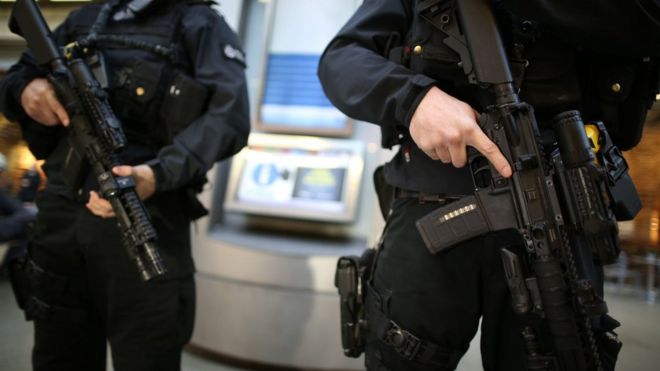
The UK may continue to face the threat of Islamist terrorism for another "20 to 30 years", the former head of MI5 has said.
Lord Evans told BBC Radio 4's Today programme the issue was a "generational problem" and that the UK needed to "persevere" with efforts to defeat it.
He also said devices connected to the internet needed to be made more secure in the face of emerging cyber threats.
And he warned that Russia was likely to try to interfere in the UK's democracy.
Lord Evans stepped down as the director general of the security service MI5 in 2013 at a time when it seemed that the terrorist threat from al-Qaeda might be subsiding.
But now, with the rise of the so-called Islamic State militant group, he said the threat was unlikely to end soon.
Lord Evans said: "There's no doubt that we are still facing a severe terrorist threat but I think its also important to put this in a slightly longer context because of right the way back from the 1990s we have been experiencing difficulties from Islamist terrorists of one sort or another.
"Over that period the threat has come and gone but the underlying threat has continued.
"Since 2013 there have been 19 attempted attacks that have been disrupted and even since the attack at Westminster we are told there have been six disruptions, so this is a permanent state of preparedness."
He added: "We're at least 20 years into this. My guess is that we will still be dealing with the long tail in over 20 years' time.
"I think this is genuinely a generational problem. I think we are going to be facing 20 to 30 years of terrorist threat and therefore we need, absolutely critically, to persevere."
Lord Evans also warned that the "internet of things" - in which vehicles and domestic devices are all connected to the internet - will need to be made more secure to reduce emerging cyber threats.
He said it was concerning that Russia had apparently been interfering in the democratic processes of some Western countries.
Lord Evans said it was something the UK needed to be alert to, as he would be "very surprised" if it was not a target as well.

Sunday, 18 June 2017

Microsoft Boosts Ransomware Defenses for Windows 10

ransomware2
Also known as WannaCrypt, the WannaCry ransomware attack hit computer systems around the world that are still using outdated software like Windows XP and Windows 7.
Microsoft made the unorthodox decision to offer security updates to users with older versions of Windows after identifying some vulnerabilities that "post elevated risk of cyber attacks by government organizations, sometimes referred to as nation-state actors or other copycat organizations," Adrienne Hall, general manager for the company's Cyber Defense Operations Center, said in a blog post.
Following the WannaCry attack, some researchers said North Korea was likely to blame, although officials in that country denied the allegation. The WannaCry malware took advantage of a Windows vulnerability that had been used for surveillance by the National Security Agency before the exploit was stolen and released by the Shadow Brokers hacking group in April.
"Due to the elevated risk for destructive cyber attacks at this time, we made the decision to take this action because applying these updates provides further protection against potential attacks with characteristics similar to WannaCrypt," Hall said in her blog post. However, the best defense against such malware is to update to a new platform that's supported with regular security updates, she added.
"It is important to note that if you're running a supported version of Windows, such as Windows 10 or Windows 8.1, and you have Windows Update enabled, you don't need to take any action," Hall said. "Older systems, even if fully up-to-date, lack the latest security features and advancements."
The decision to offer updates for unsupported software "should not be viewed as a departure from our standard services policies," Eric Doerr, general manager of the Microsoft Security Response Center, said in a separate post on Microsoft's TechNet site.
Windows Support

Thursday, 1 June 2017

HP recall battery - How to find out if YOUR HP laptop battery is at risk of catching fire

Technology firm HP, have a release a major warning to customers about a potential fire hazard from some of their laptops.
It's thought the issue, which appears to be a problem with the battery, is affecting over 100,000 machines.
HP is now advising customers to cease use of affected laptops immediately.
The laptops hit by the problem include HP ProBook, HP ENVY, Compaq Presario, and HP Pavilion Notebook Computers sold worldwide from March 2013 through October 2016.
In a statement, HP said: "These batteries have the potential to overheat, posing a fire and burn hazard to customers. HP urges customers to recheck their batteries, even if they did so previously, and were told they were not affected.
HP Support Number
HP Laptops

What HP Said
HP has said its primary concern is for the safety of its customers and it is proactively notifying users and will provide a replacement battery for each verified, eligible battery, at no cost
Speaking about the problems HP added: "On January 24, in cooperation with various government regulatory agencies, HP is announcing the expansion of a June 2016 worldwide voluntary safety recall and replacement program for certain notebook computer batteries.
"This recall involves HP lithium-ion battery packs for notebook computers sold worldwide from March 2013 through October 2016.
"Less than 1% of all HP notebook computers sold during this timeframe contained an affected battery."
This latest problem for HP comes after similar issues hit the firm last year.
Thousands of laptops across the UK were recalled in July due to a fire risk caused by unsafe batteries.
Some HP and Compaq laptops were found to pose a danger to consumers due to overheating batteries which could potentially cause a fire.
For HP Customer Support you can Visit HP Computer Support
Related Articles


Saturday, 20 May 2017

Cyber attack: Latest evidence indicates 'phishing' emails not to blame for global hack

www.telegraph.co.uk/technology/2017/05/15/nhs-cyber-attack-latest-authorities-warn-day-chaos-ransomware/
Latest evidence suggests "phishing" emails are unlikely to have caused the global cyber attack that wreaked havoc at dozens of NHS trusts and hit hundreds of thousands of computers in 150 countries.
Security experts have disputed claims that the virus was spread through suspicious emails, saying that computers were vulnerable to the bug regardless of how vigilant users were. Experts said that unless IT departments patched the virus and backed up their files they could be hit by the attacks.
Affected NHS trusts were criticised for not adding the patch despite warnings from NHS Digital a month ago that they were vulnerable to a possible attack.
Vladimir Putin has blamed the US for the global cyber attack that has crippled computer systems around the world since Friday.
Putin said Russia had "nothing to do" with the attack and blamed the US for creating the hacking software that affects Microsoft computers.
reansomware
"Malware created by intelligence agencies can backfire on its creators," said Putin, speaking to media in Beijing. He added that global leaders needed to discuss cyber security at a "serious political level" and said the US has backed away from signing a cyber security agreement with Russia. 
 
Authorities fear a second wave of the "WannaCry" ransomware could hit systems as people return to work and switch on their computers on Monday morning.
Japanese computer experts said around 2,000 PCs had been affected while the Chinese news agency Xinhua reported that almost 30,000 had been hit.
Authorities had warned of a day of chaos ahead of Monday, with the National Cyber Security Centre saying that existing infections could spread through computer systems.
NHS systems appeared to be largely up and running on Monday, although seven out of the 47 trusts hit by last week's attack are still seeking emergency support, according to NHS Digital.
Patients are being warned of slow service at surgeries, but patient data does not appear to have been compromised. The Home Secretary Amber Rudd will hold a meeting of the emergency COBRA committee later today.
The WannaCry ransomware, which locks computer systems and demands $300 (£230) in Bitcoin, hit over 200,000 computers on Friday and the impact continued to be felt across the weekend. Around £33,000 in ransoms have been paid to date, according to the analysis of Bitcoin wallets.
On Sunday night, Microsoft slammed the US spy agency that had originally developed software that allowed the ransomware attack to infect computers. The "Eternal Blue" tool developed by the National Security Agency had been dumped onto the public internet by a hacking group known as the Shadow Brokers.
It was then used by the still-anonymous cyber criminals to infect PCs with Friday's ransomware.
"The governments of the world should treat this attack as a wake-up call," In a statement, Microsoft president Brad Smith said. "Repeatedly, exploits in the hands of governments have leaked into the public domain and caused widespread damage. An equivalent scenario with conventional weapons would be the U.S. military having some of its Tomahawk missiles stolen."
 
Microsoft released a patch over the weekend for the Eternal Blue vulnerability that defends against it even with older versions of Windows.
Avast Antivirus Support
Click here to read more

Monday, 15 May 2017

Microsoft warns ransomware cyber-attack is a wake-up call


A cyber-attack that has hit 150 countries since Friday should be treated by governments around the world as a "wake-up call", Microsoft says.
It blamed governments for storing data on software vulnerabilities which could then be accessed by hackers.
It says the latest virus exploits a flaw in Microsoft Windows identified by, and stolen from, US intelligence.
There are fears of more "ransomware" attacks as people begin work on Monday, although few have been reported so far.
Many firms have had experts working over the weekend to prevent new infections. The virus took control of users' files and demanded $300 (£230) payments to restore access.
The spread of the WannaCry ransomware attack slowed over the weekend but the respite might only be brief, experts have said. More than 200,000 computers have been affected so far.
BBC analysis of three accounts linked to the ransom demands suggests about $38,000 (£29,400) had been paid by Monday morning.
However, the ransomware warning said that the cost would double after three days, so the payments may increase. It threatens to delete files within seven days if no payment is made.
The effect in Asian nations so far on Monday has been limited. South Korea said just nine cases of ransomware had been found, giving no further details.
Australian officials said so far only three small-to-medium sized businesses had reported being locked out of their systems while New Zealand's ministry of the business said a small number of unconfirmed incidents were being investigated.
In Japan, both Nissan and Hitachi reported some units had been affected, while in China energy giant PetroChina said that at some petrol stations customers had been unable to use its payment system.

Norton Antivirus Support Number | Outlook Customer Support Number

Friday, 14 April 2017

HP Is Back on Top

IDC reported preliminary global PC shipments of 60.3 million units (down 11.9% quarter-over-quarter, up 0.6% year-over-year) in the calendar first quarter, above our estimates of 58.8 million units (down 14.2% quarter-over-quarter, down 1.9% year-over-year), driven by healthy commercial demand as well as vendors locking in supply of components.
We highlight continued component supply constraints and pricing pressures, with vendors optimising mix toward higher-end (higher average selling price (ASP)) PCs. We also note the end of [ Microsoft (ticker: MSFT)] Windows Vista support lifecycle (although its share of the PC installed base is minimal).
We highlight that the PC market has continued to strengthen, with strong first-quarter Notebook build numbers posted by Taiwan original design manufacturer (ODM) companies as well (down 12% quarter-over-quarter, up 12% year-over-year versus our expectations of a loss of 20% quarter-over-quarter, up 1% year-over-year). Our global PC unit shipment forecast stands for calendar 2017/2018 at 260 million/265 million units. We expect a modest pickup in replacement rates in 2017, driven by an aging install-base as well as [Alphabet (GOOGL)] Chromebooks and VR-enabled gaming notebooks.
HP (HPQ) is back at No. 1, with potential upside to our estimates. IDC reported preliminary HP shipments of 13.1 million units (down 14.1% quarter-over-quarter, up 13.1% year-over-year) in line with our estimates of 13.1 million units (down 14.2% quarter-over-quarter, up 13.1% year-over-year). HP reclaimed its No. 1 spot for the first time since first-quarter 2013, after outperforming the market again (up 13% year-over-year growth versus up 0.6% year-over-year market growth). For the first quarter, HP held market share of 21.8% (up 240 basis points year-over-year). We note that HP is seeing accelerated growth in its PC business (up 13.1% year-over-year versus 6.8% year-over-year in the fourth quarter and up 3.6% year-over-year in the third quarter) and believe this suggests potential upside to our HP fiscal-second-quarter Personal Systems Group (PSG) estimate of $7.5 billion (down 8.8% quarter-over-quarter, up 7.2% year-over-year). We see sustained positive momentum in the PC business at HP. We reiterate our Outperform rating and $19 target price.
Lenovo (LVNGY) dropped to No. 2, coming in at 20.4% (down 200 basis points quarter-over-quarter, up 20 basis points year-over-year). We note here that Lenovo saw shipment grow on a year-over-year basis, with 1.7% year-over-year growth, but still fell behind HP in the leadership board. Overall, the top five accounted for 71.9% of global PC shipments, in the quarter, up from 68.1% in the same period last year.
Apple (AAPL) maintaining a unit share of about 7%. Apple shipments came in at 4.2 million units (down 21.6% quarter-over-quarter, up 4.1% year-over-year), Apple enjoyed a market share of 7% (down 70 basis points quarter-over-quarter, up 30 basis points year-over-year), but we believe rivals are increasingly focusing on its core target market, the premium high end. We note that the Mac business contributes around about 5% of Apple’s overall Gross Profit. As discussed in our note Scaling the Annuity, we see material potential for Apple’s Services. With Services being about a 70% gross-margin business, this continued growth continues to support our view that Services can grow from 15% to a third of gross profit long term. We reiterate our Outperform rating and $160 target price.